
Disproportionality in Subsidy Enrollment

Disproportionality in Subsidy Enrollment

From 2016 to 2024, subsidized child care programs have enrolled between 27 - 42 percent of the income-eligible population of children under 5 years of age in Washington State. Black/African American children have been consistently over-represented, while other groups have, in most years, been slightly under-represented to varying degrees.

Racial/Ethnic Disproportionality Ratios for Child Care Subsidy Uptake, School Years 2016-2024
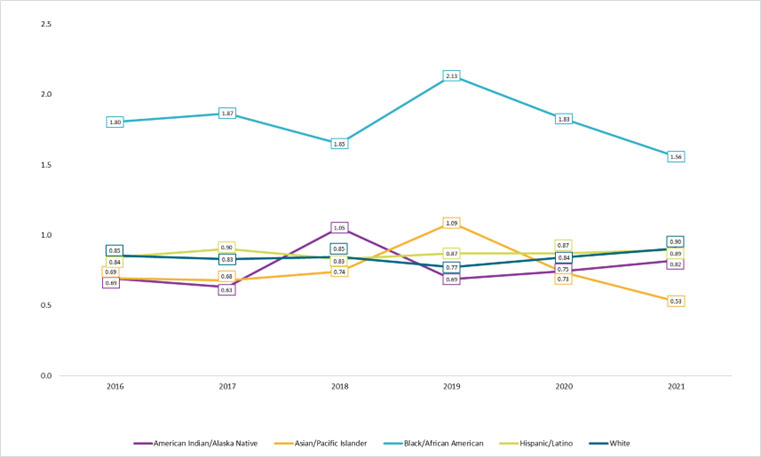
  Line graph showing racial/ethnic disproportionality ratios for child care subsidy uptake, school years 2016-2024. The patterns of representation are fairly consistent over the years. In 2016,  Black/African American children were over-represented in subsidy participation, at 1.85 times their presence in the eligible population, and in 2024 they participated at 1.64 times their presence in the population. Both Hispanic/Latino and White children receive subsidy at nearly the same rate that they’re present in the eligible population. In 2016, Hispanic/Latino children participated at 0.84, and White children at 0.85 times their presence in the population. In 2024, Hispanic/Latino children participated at 0.98 and White children at 0.93 times their presence in the population. American Indian/Alaska Native children are slightly under-represented in subsidy participation. In 2016, American Indian/Alaska Native children participated at 0.71 times their representation in the population, while Asian/Pacific Islander children participated at 0.72 times their representation in the population. In 2024, American Indian/Alaska Native children participated at 0.7 times their representation in the population, while Asian/Pacific Islander children participated at 0.64 times their representation in the population.