
Disproportionality in ECEAP Enrollment

Disproportionality in ECEAP Enrollment

Each year, around 15,000 children are enrolled in Washington's Early Childhood Education Assistance Program (ECEAP). DCYF tracks disproportionality in ECEAP enrollment using a Disproportionality Ratio. A disproportionality ratio of 1.0 would indicate that children of that race/ethnicity are enrolled in ECEAP at the same rate they exist in the underlying income-eligible population. For the past few years, Black/African American children have been slightly over-represented in ECEAP enrollment, while American Indian/Alaska Native and Asian/Pacific Islander children have been slightly under-represented.

Racial/Ethnic Disproportionality Ratios for ECEAP Enrollment, School Years 2016-2024
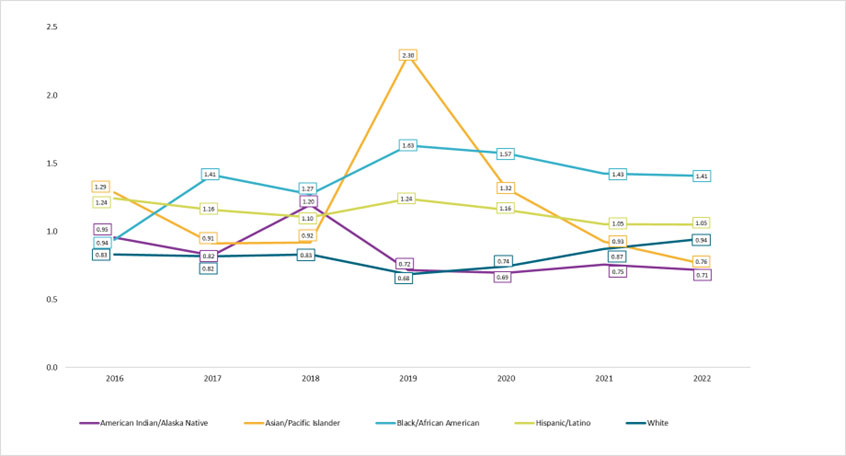
  Line graph showing racial/ethnic disproportionality ratios for ECEAP enrollment, school years 2016-2024. The patterns of representation are fairly consistent over the years. After 2016, when Black/African American children were represented in ECEAP participation at 0.94 times their presence in the eligible population, they have been somewhat over-represented in ECEAP participation. By 2024 they participated in ECEAP at 2.01 times their presence in the eligible population. The representation of other groups has varied a bit each year, but in most years is fairly close to proportionate. In 2016, Hispanic/Latino children participated at 1.24 times their presence in the population, and in 2024 they participated at 0.89 times their population presence. In 2016, White children participated in ECEAP at 0.83 times their presence in the population, and in 2024 they participated at 1.11 times their population presence. In 2016, American Indian/Alaska Native children participated in ECEAP at 0.95 times their representation in the population, and in 2024 they participated at 0.64 times their population presence. In 2016, Asian/Pacific Islander children participated at 1.29 times their representation in the population, and in 2024 Asian/Pacific Islander children participated at 0.71 times their representation in the population.