
Family Practice Model (FPM)
Please visit DCYF’s Office of Innovation, Alignment, and Accountability’s (OIAA) Child Welfare Safe Reduction dashboard.
This dashboard shows information about child welfare intakes in Washington state. Fewer placements in out-of-home care does not always mean that families need less help. This dashboard tracks both out-of-home placements and referrals back to Child Protective Services (CPS). Looking at both measures together helps us better understand the quality of the services that we provide to families engaged with CPS.
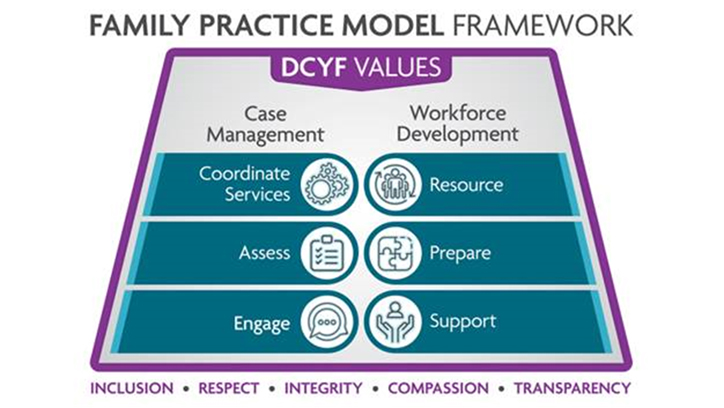
The Family Practice Model (FPM) is the “how.” It is the infrastructure Child Welfare uses to carry out the goal of improving the quality and intention of practice.
FPM improves quality of practice
FPM improves quality of practice by ensuring staff have:
- Clear guidance and structure for engaging, assessing, and planning with families
- Tools and resources that are easy to access and relevant to real casework
- Consistent processes so everyone understands how changes will be implemented
- Support from leadership so staff can do good work and feel prepared
Quality improves when people know what to do, have the right tools, and receive steady support.
FPM improves intention of practice
FPM improves intention of practice by helping staff build supportive, person-centered relationships and uphold values in their daily work by:
- Operationalizing values in practice (integrity, compassion, inclusion, respect, transparency)
- Including workforce voice in decisions and practice, ensuring changes are done with staff rather than to them
Intention grows when staff understand the “why,” feel valued, and see the system responding to their needs.
Agency Values
Inclusion – Seek and actively engage, encourage, and prioritize equitable participation within a family centered approach.
Respect – Value and honor another person for who they are, showing regard for their culture, rights, and traditions.
Compassion – The act of being respectful, empathetic, and encouraging to those we work and interact with.
Integrity – Self-awareness and being accountable, responsible, truthful, and actions are consistent with values.
Transparency – Interact in a way that everyone sees how and why actions are performed through open communication and accountability.
