Housing Instability
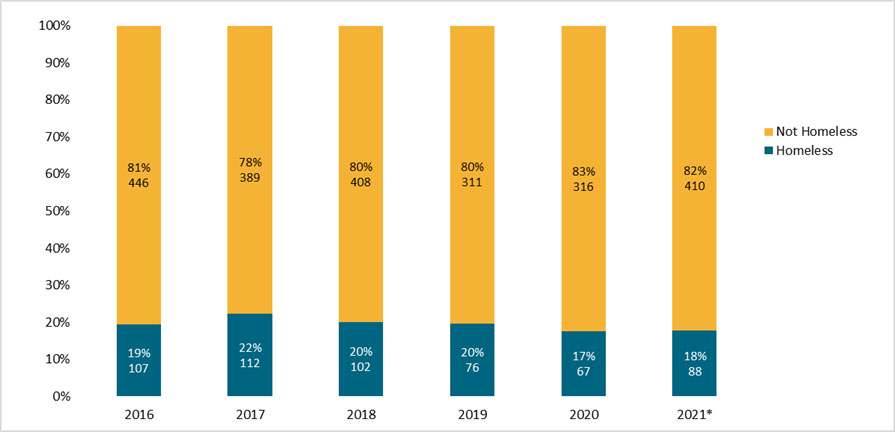
Housing instability is a balancing indicator for our outcomes related to creating successful transitions to adulthood. Youth and young adults who exit the foster care system without being placed into a permanent family through reunification, adoption, or guardianship are often referred to as "aging out" of foster care. These youth are at higher risk of becoming homeless or unstably housed than those who have a family to support them at this critical life transition. Overall, across the past five years, 16% of former foster youth experienced an episode of housing instability or homelessness within 12 months of leaving care. Annual rates of homelessness among former foster youth have declined over the course of those years however, most notably in 2024. The proportion experiencing homelessness was 22% in 2020, 14% in 2021, 15% in both 2022 and 2023, and 9% in 2024.
Analysis has also been done about the housing instability of youth and young adults (ages 12 to 25) who are released from a Juvenile Rehabilitation institution. Until 2021, the rate of homelessness for youth and young adults leaving Juvenile Rehabilitation institutions largely mirrored those of former foster youth. In more recent years however, new programs and resources have reduced homelessness among former foster youth, while rates of homelessness among youth and young adults leaving JR have changed very little. Overall, across the past five years, 21% experienced an episode of housing instability or homelessness within 12 months of discharge from JR. The annual rates over those years have fluctuated between 18% and 24%, without any clear upward or downward trend. The proportion experiencing homelessness was 19% in 2020 and 2021, 24% in 2022, 19% in 2023, and 18% in 2024.
Homelessness Among Former Foster Youth (Ages 18-24) within 12 Months of Leaving Foster Care, 2020-2024
Homelessness Among Former Foster Youth (Ages 18-24) within 12 Months of Leaving Foster Care, 2020-2024
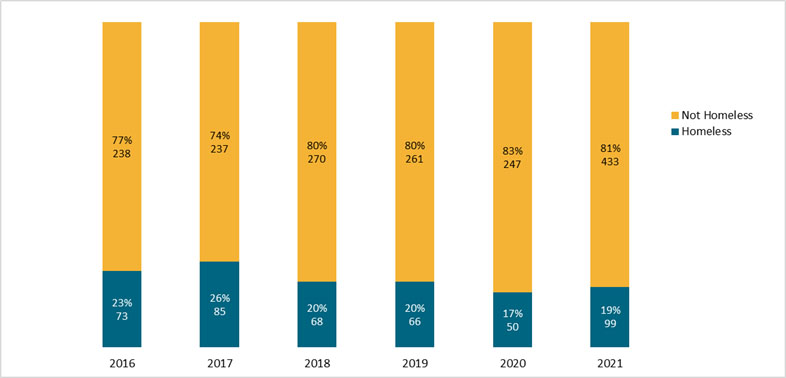
Homelessness Among Youth and Young Adults (Ages 12-24) within 12 Months of Leaving Juvenile Rehabilitation, 2020-2024
Homelessness Among Youth and Young Adults (Ages 12-24) within 12 Months of Leaving Juvenile Rehabilitation, 2020-2024