
According to Revised Code of Washington (RCW) chapter 13.22, Juvenile Rehabilitation (JR) institutions are required to document the use of room confinement and isolation (RCI) and report these data to the Department of Children, Youth, and Families (DCYF). On an annual basis, DCYF must post the following information for all instances of RCI lasting one hour or more:
- The number of times isolation and room confinement were used
- The circumstances leading to the use of isolation and room confinement
- The duration of each use of isolation and whether, for each instance of isolation, the use of isolation lasted more than four hours within a twenty-four hour period
- Whether or not supervisory review occurred and was documented for each instance of isolation and room confinement
- The race and age of the juvenile for each instance of isolation and room confinement
- Whether or not a medical assessment or review and a mental health assessment or review were conducted and documented for each instance of isolation
- If the affected juvenile was not afforded access to medication, meals, and reading material during the term of confinement for each instance of isolation and room confinement.
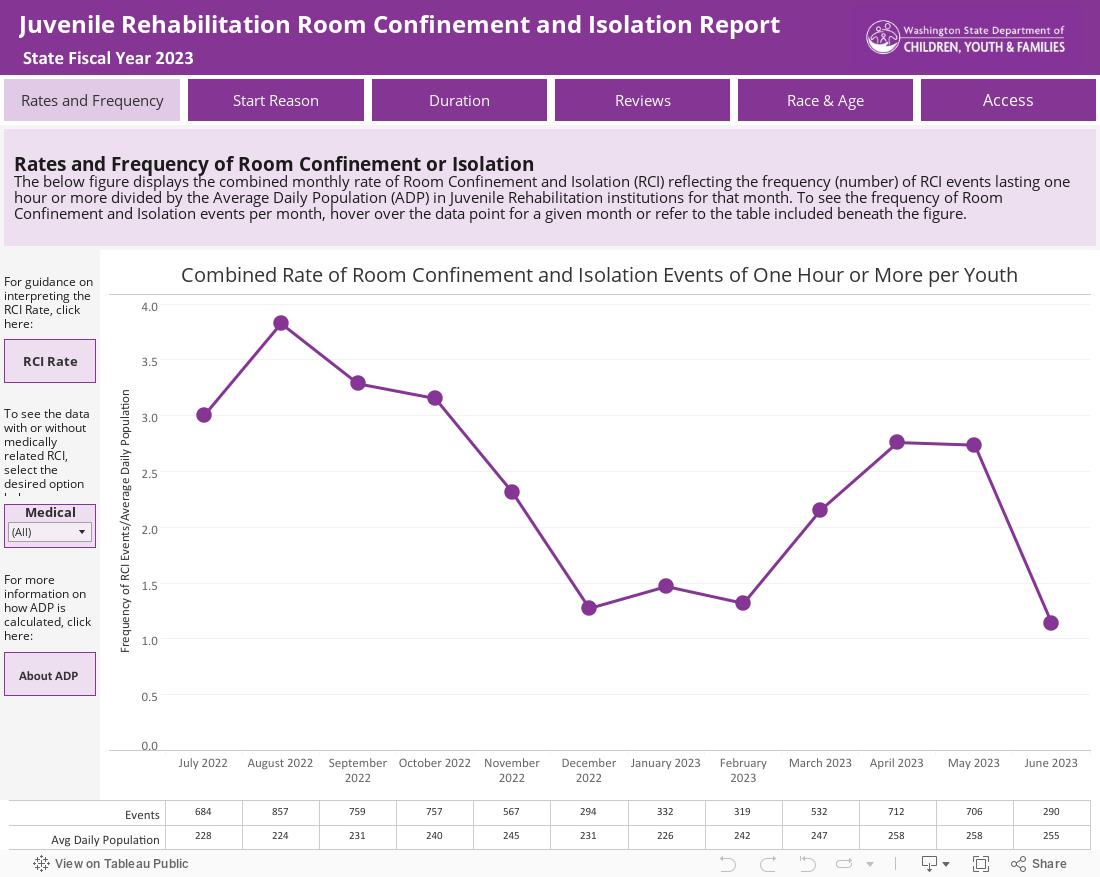
In response to these requirements, DCYF has generated a dashboard displaying the pertinent data. Descriptions of the data are included alongside graphs. Additionally, further context for understanding and interpreting these data is provided here and in a written report prepared for the legislature.
Footnotes
Data Source: Juvenile Rehabilitation Automated Client Tracking (ACT)
WSRDAC/M Reporting Standard: Yes; AI/AN-Multi included in AI/AN counts and Black-Multi included in Black counts.
Data Files:
- RCI Monthly Counts | Data.WA | State of Washington
- RCI Start Reason | Data.WA | State of Washington
- RCI Measures | Data.WA | State of Washington
Suggested Citation: Icenogle, G., French, J. & Fox A. M. (2024). Juvenile Rehabilitation Room Confinement and Isolation Report, State Fiscal Year 2023-2024. Department of Children, Youth, and Families, Office of Innovation, Alignment, and Accountability. Olympia, WA.
Questions? For questions about the dashboard or underlying data, email oiaa@dcyf.wa.gov.
Interpreting the Data
Definitions According to Chapter 13.22
Room Confinement - “Room confinement” means a juvenile is separated from the youth population and placed in a room or cell that the juvenile is assigned to for sleeping, other than during normal sleeping hours or interim rest hours. "Room confinement" does not include time a youth requests to spend in his or her room or rest periods in between facility programming. Juveniles are in room confinement from the moment they are separated from others until they are permitted to rejoin the population.
Isolation - "Isolation" means confinement that occurs (a) when a youth is separated from the youth population and placed in a room for longer than 15 minutes for the purpose of discipline, behavior modification, or due to an imminent threat to the safety of the youth or others; and (b) in a room other than the room assigned to the youth for sleeping. Juveniles are in isolation from the moment they are separated from others until they have rejoined the population. Juveniles who are pregnant shall not be put into isolation. Maintaining appropriate gender separation does not constitute isolation.
As noted in the above definitions from RCW 13.22, there are several exceptions to reporting instances when a youth may be in their room. The following situations are not considered room confinement: (1) any self-requested time spent in one’s room, (2) time spent in one’s room during rest periods in between facility programming, and (3) time spent in one’s room during normal sleeping hours or interim rest hours. It is also important to note that only Room Confinement and Isolation events lasting 1 hour or more are reported here, per RCW 13.22.
Although RCW 13.22 provides guidance regarding what “counts” as Room Confinement, there are situations in practice that do not clearly fit within these definitions. For instance, if youth are confined to their rooms while staff respond to an emergent incident, it is unclear whether these events ought to be considered a “rest period” for which reporting is not required. Similarly, for a youth who went on Room Confinement right before shift change, when all youth are typically confined to their rooms, it is unclear whether facilities ought to log the entire period of confinement, inclusive of time during shift change or mark the end of Room Confinement at the start of shift change. Conversations with facility staff indicated that there is variation in how such situations are being tracked. Variation in how staff document these events should be considered when interpreting these data. Lastly, while RCW 13.22 provides no guidance on how or whether to report on Room Confinement or Isolation due to medical conditions (e.g., COVID-19 quarantine), these data have been provided within the dashboard as an optional filter.